As a regulatory leader, your responsibility doesn’t end with market approval, it begins there. This sentiment echoes across boardrooms and regulatory strategy discussions as Post market surveillance medical devices requirements become an increasingly important part of medical device lifecycle management.
In an environment where real-world performance, patient safety, and global compliance are under continuous regulatory focus, Post-Market Surveillance (PMS) is no longer only a regulatory obligation; it has become a strategic advantage for manufacturers. The ability to collect, evaluate, and act upon post-market data allows manufacturers to identify potential risks, monitor device performance, maintain compliance, and ensure continued patient safety throughout the product lifecycle.
While the U.S. FDA and the European Union (EU) both prioritize PMS activities, their regulatory approaches differ. The FDA framework combines mandatory reporting mechanisms such as Medical Device Reporting (MDR) with other post-market monitoring activities, while EU MDR 2017/745 establishes a more proactive, lifecycle-based PMS framework integrated into the manufacturer's Quality Management System (QMS). For companies operating globally, understanding these differences in FDA post-market surveillance and post-market surveillance EU MDR requirements is essential for maintaining regulatory compliance, protecting brand reputation, and ensuring continued market access.
Related Service
Need Support with Medical Device Post-Market Surveillance?
Strengthen your medical device surveillance program with DDReg Pharma's support for post-market surveillance planning, vigilance, complaint handling, risk management, trend analysis, and regulatory reporting.
Explore Medical Device Regulatory Services →
What is Post-Market Surveillance for Medical Devices?
Post-market surveillance (PMS) refers to the ongoing and systematic collection, analysis, and interpretation of information related to a medical device after it has been placed on the market. Post-market surveillance helps manufacturers understand how devices perform under real-world conditions and identify potential safety concerns that may not have been observed during pre-market evaluation.
The primary objectives of medical device post-market surveillance include:
Monitoring continued device safety and performance
Identifying previously unknown risks
Evaluating changes in the benefit-risk profile
Supporting corrective and preventive actions
Maintaining regulatory compliance throughout the device lifecycle
Under EU MDR 2017/745, manufacturers are required to plan, establish, document, implement, maintain, and update a PMS system proportionate to the device risk class and appropriate for the device type. The PMS system must also be an integral part of the manufacturer's QMS.
Why is Post-Market Surveillance Important for Medical Devices?
Once a medical device receives market approval, continuous monitoring becomes essential because the device is exposed to broader real-world conditions, patient populations, and usage environments. An effective PMS medical devices strategy helps manufacturers move beyond reactive compliance and develop a proactive approach toward safety and performance management.
A strong PMS system enables manufacturers to:
Protect Patient Safety -The primary purpose of PMS is to identify potential safety issues and ensure appropriate actions are taken to protect patients. Continuous monitoring allows manufacturers to detect trends, investigate complaints, and implement corrective actions when required.
Maintain Regulatory Compliance - Medical device regulations require manufacturers to demonstrate continued oversight of device safety and performance after commercialization.
PMS supports compliance with:
FDA Medical Device Reporting requirements
EU MDR PMS obligations
Vigilance reporting requirements
Quality management system requirements
Support Risk Management and CAPA - Post-market data provides valuable inputs into risk management processes.
PMS findings may result in:
Risk reassessment
CAPA initiation
Design improvements
Labelling updates
Field Safety Corrective Actions (FSCAs)
Improve Device Performance - Real-world feedback allows manufacturers to understand actual device usage and identify opportunities for improvement. PMS therefore contributes not only to compliance but also to continuous product improvement.
How Does Medical Device Post-Market Surveillance Work?
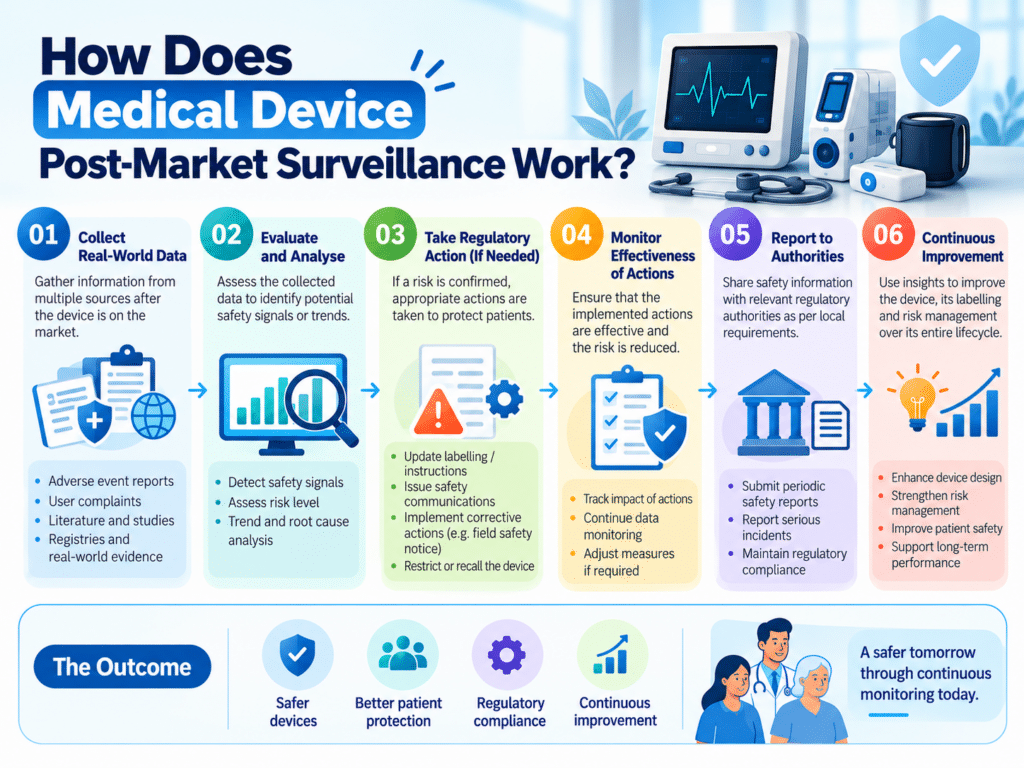
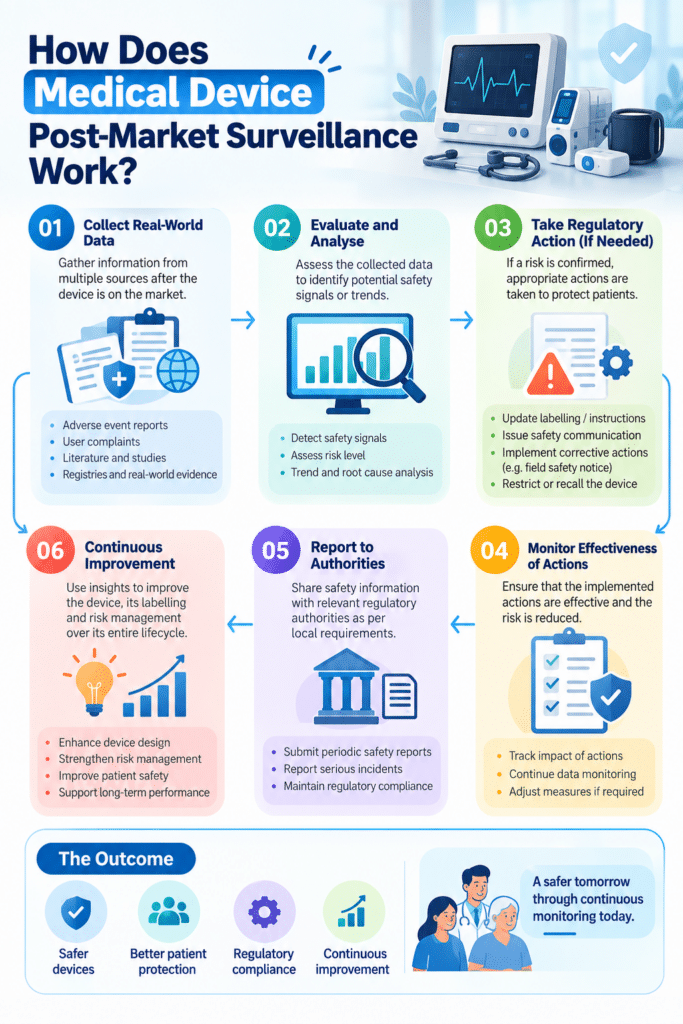
Medical device post-market surveillance is a continuous lifecycle process involving the collection, analysis, evaluation, and use of post-market information.
A typical PMS process includes:
Data Collection -Manufacturers collect information from multiple sources, including:
Complaint records
Vigilance reports
User feedback
Distributor information
Clinical data
Literature reviews
Post-market clinical follow-up (PMCF).
Where Applicable EU MDR Annex III specifically identifies data sources such as serious incidents, non-serious incidents, trend reporting information, literature, databases, user feedback, and information about similar devices as inputs for PMS planning.
Data Analysis and Evaluation - Collected information is analysed to identify:
Safety signals
Device performance issues
Emerging risks
Changes in benefit-risk balance
Manufacturers must evaluate whether identified issues require further investigation or regulatory action.
Risk Assessment - The collected PMS information is reviewed through risk management processes.
Manufacturers assess:
Severity of potential harm
Frequency of occurrence
Impact on device safety
Need for corrective actions
Corrective and Preventive Actions -Where required, PMS findings lead to appropriate actions, including:
CAPA activities
Device modifications
Safety communications
Field Safety Corrective Actions
Regulatory notifications
An effective PMS system ensures that post-market information creates a continuous feedback loop for improving device safety and performance.
What Are FDA Post-Market Surveillance Requirements?
In the United States, FDA post-market surveillance activities ensure that medical devices continue to meet safety and performance expectations after they are placed on the market. PMS activities in the U.S. are primarily supported through Medical Device Reporting (MDR) requirements under 21 CFR Part 803. MDR is one of the important post-market surveillance tools used by FDA to monitor device performance, identify potential device-related safety issues, and support benefit-risk assessments.
However, FDA post-market surveillance is broader than MDR reporting alone. It includes multiple activities such as complaint handling, corrections and removals, device tracking (where applicable), post-approval studies, and post-market surveillance studies under Section 522 of the Federal Food, Drug, and Cosmetic Act.
USA Medical Device Compliance
Need FDA Post-Market Compliance Support?
Maintain FDA medical device compliance with support for adverse event reporting, complaint handling, recalls, corrective actions, vigilance, post-market requirements, and regulatory submissions.
Explore USA Medical Device Regulatory Services →
Key Stakeholders and Responsibilities
Manufacturers and Importers -Manufacturers and importers have important responsibilities under FDA Medical Device Reporting requirements. They must report device-related events where they become aware that:
A device may have caused or contributed to a death
A device may have caused or contributed to a serious injury
A device malfunction could recur and would be likely to cause or contribute to death or serious injury
Manufacturers must also establish and maintain adverse event files and appropriate MDR procedures to support regulatory compliance.
User Facilities - User facilities, including hospitals and healthcare institutions, also have reporting responsibilities under FDA regulations. User facilities are required to report:
Device-related deaths to FDA and the manufacturer
Serious injuries to the manufacturer or FDA if the manufacturer is unknown
They must also maintain records related to reportable device events.
Distributors - Distributors are required to maintain complaint and incident records related to medical devices. Unlike manufacturers and importers, distributors generally do not have routine MDR reporting obligations; however, they must maintain appropriate records and provide information when requested by FDA.
Timelines for MDR Submission in US-FDA
Your original reporting timelines are retained:
30 Calendar Days - Manufacturers and importers must submit MDR reports within 30 calendar days after becoming aware of information that reasonably suggests that a device may have caused or contributed to a death, serious injury, or reportable malfunction.
5 Workdays - A report must be submitted within 5 workdays when a manufacturer becomes aware of information requiring remedial action to prevent an unreasonable risk of substantial harm to public health.
User Facility Reporting Timeline - User facilities have specific reporting obligations depending on the type of event and applicable FDA requirements.
Source - FDA.GOV
Electronic Medical Device Reporting (eMDR)
FDA requires manufacturers and importers to submit mandatory MDR reports electronically through FDA-supported electronic submission systems. Electronic Medical Device Reporting (eMDR) allows FDA to receive, process, review, and archive medical device reports in a standardized electronic format.
The electronic submission process improves:
Data consistency
Reporting efficiency
Regulatory review processes
Manufacturers may use FDA-supported electronic reporting methods, including:
eSubmitter tools
Electronic Submission Gateway (ESG)
MAUDE Database
Submitted MDR information is made publicly available through the Manufacturer and User Facility Device Experience (MAUDE) database. MAUDE supports transparency by allowing stakeholders to review reported medical device adverse events and identify potential safety signals. However, MDR reports should be interpreted carefully because submission of an MDR does not automatically mean that the device caused the reported event. FDA evaluates MDR information along with other available data sources when assessing device safety.
What Is FDA Section 522 Under Post-Market Surveillance?
In addition to MDR reporting, FDA may require manufacturers to conduct formal post-market surveillance studies under Section 522 of the Federal Food, Drug, and Cosmetic Act. Section 522 surveillance involves the active, systematic, and scientifically valid collection, analysis, and interpretation of data regarding a marketed medical device.
FDA may require post-market surveillance studies for certain devices where:
Device failure could reasonably result in serious adverse health consequences
The device is implanted for more than one year
The device is expected to have significant use in pediatric populations
The device is life-supporting or life-sustaining outside a user facility
These studies help FDA obtain additional information about device safety, effectiveness, and long-term performance.
Recent FDA PMS Developments (2023–2026)
FDA continues to focus on improving post-market data collection, surveillance processes, and the use of real-world information to support medical device safety evaluation.
Key areas of development include:
Improving electronic reporting systems
Enhancing post-market data analysis
Increasing use of real-world evidence approaches
Supporting harmonisation efforts across global regulatory frameworks
Manufacturers should continue monitoring FDA guidance documents and CDRH communications to ensure that their PMS systems remain aligned with current expectations.
What Are EU MDR Post-Market Surveillance Requirements Under EU MDR 2017/745?
EU MDR Compliance
Need Support with EU MDR Post-Market Surveillance?
Navigate EU MDR post-market requirements with support for PMS planning, PSURs, vigilance reporting, trend reporting, clinical follow-up, risk management, and regulatory compliance.
Explore EU Medical Device Regulatory Services →
In the European Union, post-market surveillance EU MDR requirements are governed by Regulation (EU) 2017/745 on Medical Devices (MDR), primarily under Chapter VII (Post-Market Surveillance, Vigilance and Market Surveillance) and Annex III (Technical Documentation on Post-Market Surveillance).
Unlike a purely reactive reporting approach, EU MDR establishes a proactive and lifecycle-based PMS framework. Manufacturers are required to establish, document, implement, maintain, and update a PMS system that is proportionate to the device risk class and appropriate for the type of device. The PMS system must also be integrated into the manufacturer’s Quality Management System (QMS).
The objective of EU MDR PMS is to ensure continuous monitoring of:
Device safety
Clinical performance
Device quality
Benefit-risk determination
Emerging safety concerns
The information collected through PMS activities must be used to support risk management, clinical evaluation updates, preventive actions, corrective actions, and continuous product improvement.
What Is an EU PMS Plan and PMS System (Articles 83–84)?
Under EU MDR, manufacturers must establish a documented PMS system supported by a PMS Plan. The PMS Plan defines how manufacturers will collect, analyse, and evaluate post-market information throughout the device lifecycle.
According to Annex III, the PMS Plan should address relevant data sources, including:
Serious incidents
Field Safety Corrective Actions (FSCAs)
Non-serious incidents
Undesirable side effects
Trend reporting information
Technical literature
Databases and registers
Feedback and complaints from users, distributors, and importers
Publicly available information about similar devices
A well-developed PMS Plan ensures that manufacturers have a structured approach for identifying risks and implementing appropriate actions throughout the product lifecycle.
PMS Reporting Documentation
EU MDR requires manufacturers to maintain appropriate PMS documentation depending on device classification.
The two main PMS reporting documents are:
Post-Market Surveillance Report (PMS Report)
For Class I devices, manufacturers must prepare a PMS Report summarizing:
PMS data collected
Analysis results
Conclusions
Preventive and corrective actions implemented
The PMS Report must be updated when necessary and made available to competent authorities upon request.
For Class IIa, Class IIb, and Class III devices, manufacturers must prepare a Periodic Safety Update Report (PSUR).
The PSUR includes:
Conclusions from PMS data analysis
Benefit-risk determination
Preventive and corrective actions
Post-market clinical follow-up (PMCF) findings where applicable
Sales information and estimated user population
Manufacturers of higher-risk devices must update PSURs at defined intervals according to MDR requirements.
Vigilance Reporting Under EU MDR (Article 87)
Vigilance reporting is a critical component of PMS medical devices compliance.
Manufacturers must report:
Serious incidents
Field Safety Corrective Actions (FSCAs)
Safety-related issues requiring regulatory attention
The purpose of vigilance reporting is to ensure that regulatory authorities are informed about significant safety concerns and that appropriate corrective actions are implemented.
What Is the Timeline for European Medical Device Approval:
2 days for serious public health threats
10 days for death or unanticipated serious deterioration in health
15 days for other serious incidents
Manufacturers must evaluate incidents and submit reports according to the applicable regulatory requirements.
Source - health.ec.europa.eu
Trend Reporting Under EU MDR (Article 88)
One of the important additions introduced under EU MDR is the requirement for manufacturers to monitor trends involving non-serious incidents and expected undesirable side effects.
Trend reporting requires manufacturers to identify statistically significant increases in:
Frequency of incidents
Severity of incidents
Device-related risks
Manufacturers must define appropriate thresholds within their PMS procedures and continuously evaluate whether observed trends require regulatory reporting or corrective actions. Trend reporting supports proactive risk management by allowing manufacturers to identify potential issues before they become major safety concerns.
EUDAMED Platform and PMS Activities
The European Database on Medical Devices (EUDAMED) is designed to improve transparency and information exchange between manufacturers, regulatory authorities, notified bodies, and other stakeholders.
EUDAMED supports multiple regulatory activities, including:
Actor registration
Clinical investigations
Vigilance information
Market surveillance activities
Manufacturers should continue monitoring European Commission updates regarding the implementation and mandatory use timelines of individual EUDAMED modules.
Role of Notified Bodies in EU MDR PMS
Notified Bodies play an important role in reviewing PMS activities for applicable medical devices. For higher-risk devices, including many Class IIb and Class III devices, Notified Bodies review relevant PMS documentation such as PSURs as part of ongoing conformity assessment activities. This provides additional external oversight and ensures that manufacturers continue meeting EU MDR requirements after-market placement.
FDA PMS vs EU MDR PMS: Key Differences
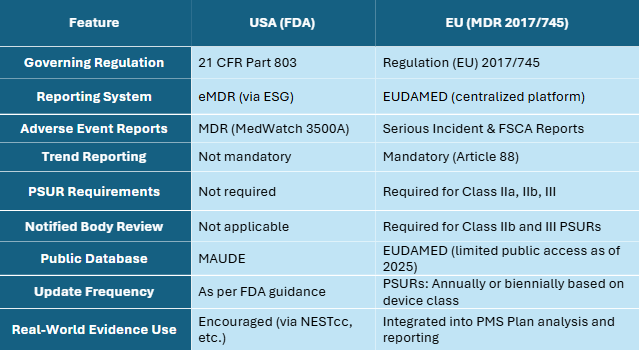
In simple terms, FDA PMS focuses strongly on monitoring and responding to device-related safety events, while EU MDR PMS requires manufacturers to establish a more structured and proactive lifecycle surveillance system. For manufacturers selling globally, an effective PMS strategy should address both frameworks rather than treating them separately.
Role of Quality Management Systems in PMS
Post-market surveillance cannot function effectively as an isolated regulatory activity. It must be integrated into the manufacturer’s overall Quality Management System (QMS Services). PMS data provides valuable information that supports quality and regulatory processes, including:
Complaint handling
Risk management
Corrective and Preventive Actions (CAPA)
Device improvements
Clinical evaluation updates
A connected PMS and QMS approach allow manufacturers to identify recurring issues, investigate root causes, and implement preventive measures before risks increase.
For example, repeated complaints related to a device component may trigger:
Complaint investigation
Risk reassessment
CAPA initiation
Design review
Regulatory assessment
Under EU MDR 2017/745, PMS activities are specifically required to be integrated into the manufacturer’s QMS. The PMS system should continuously generate information that supports risk management, preventive and corrective actions, and technical documentation updates. PMS activities should also support ongoing risk management principles described in ISO 14971, ensuring that post-market information contributes to continuous benefit-risk evaluation.
What Are the Key PMS Challenges for Medical Device Manufacturers?
Although PMS is essential for maintaining device safety and compliance, manufacturers face several challenges when managing post-market activities.
Managing Global Regulatory Differences
Manufacturers operating in multiple regions must comply with different regulatory frameworks. A device marketed in the U.S. and Europe may require different approaches for:
Incident reporting
Regulatory communication
Surveillance activities
Maintaining a global PMS strategy while meeting regional requirements requires strong regulatory planning.
Handling Increasing Volumes of Data
Modern medical devices generate significant amounts of information from various sources, including:
Complaint systems
Electronic records
Clinical follow-up activities
User feedback
Real-world evidence
Manufacturers need effective systems to collect, analyse, and interpret this information.
Identifying Emerging Risks
One of the biggest challenges in PMS is detecting potential risks before they become major safety concerns.
Manufacturers must continuously evaluate:
Complaint trends
Incident patterns
Device performance changes
User feedback
Maintaining Cross-Functional Collaboration
Successful PMS requires coordination between:
Quality Assurance
Clinical Affairs
Engineering
Manufacturing
Risk Management Teams
Poor communication between departments can delay investigations and corrective actions.
Keeping Up with Regulatory Changes
Medical device regulations continue to evolve.
Manufacturers must continuously monitor:
FDA guidance updates
EU MDR developments
MDCG publications
International regulatory expectations
Regulatory intelligence Services is therefore an important part of an effective PMS strategy.
What Are the Benefits of an Effective PMS Strategy?
A strong medical device post-market surveillance system provides benefits beyond regulatory compliance.
Improved Patient Safety
The primary objective of PMS is ensuring that potential risks are identified early and appropriate actions are taken to protect patients.
Better Regulatory Compliance
A structured PMS system helps manufacturers demonstrate compliance with:
FDA post-market surveillance requirements
EU MDR PMS obligations
Global medical device regulations
Improved Product Quality
Real-world device performance information helps manufacturers identify opportunities for:
Product improvement
Design optimisation
Manufacturing improvements
Risk reduction
Better Lifecycle Management
PMS information supports important product decisions throughout the device lifecycle, including:
Design changes
Labelling updates
Clinical evaluation updates
Market continuation decisions
Stronger Customer and Regulatory Confidence
Manufacturers with effective PMS processes demonstrate commitment to quality, safety, and continuous improvement.
This strengthens confidence among:
Patients
Healthcare professionals
Regulatory authorities
Business partners
How Can DDReg Support Medical Device Post-Market Surveillance?
DDReg supports medical device regulatory services for manufacturers in managing complex post-market surveillance requirements across global regulatory frameworks.
Our regulatory experts assist companies with:
PMS strategy development
FDA and EU MDR compliance support
PMS documentation preparation
Vigilance reporting support
PSUR preparation
Regulatory intelligence
Risk management support
Lifecycle management activities
With expertise across global medical device regulations, DDReg helps manufacturers establish effective PMS systems that support regulatory compliance, patient safety, and long-term market success.
Frequently Asked Questions (FAQs)
What is post-market surveillance for medical devices?
Post-market surveillance is the continuous process of collecting, analysing, and evaluating information about a medical device after it is placed on the market to ensure continued safety, performance, and regulatory compliance.
Why is post-market surveillance important for medical devices?
PMS helps manufacturers identify safety risks, monitor device performance, maintain regulatory compliance, and implement corrective actions when required.
What are PMS requirements under EU MDR?
EU MDR requires manufacturers to establish a documented PMS system under Chapter VII and Annex III. The system must include PMS planning, data collection, analysis, reporting, and corrective action processes.
What is FDA post-market surveillance?
FDA post-market surveillance includes activities such as Medical Device Reporting (MDR), complaint handling, post-market surveillance studies, corrections and removals, and other safety monitoring activities.
What is the difference between FDA PMS and EU MDR PMS?
FDA PMS focuses strongly on adverse event reporting and safety monitoring, while EU MDR requires a proactive lifecycle-based PMS system integrated into the manufacturer’s Quality Management System.
What Is FDA Section 522 Post-Market Surveillance?
Section 522 allows FDA to require certain manufacturers to conduct post-market surveillance studies for specific devices when additional post-market information is needed to address safety or other regulatory concerns.
What Is FDA Medical Device Reporting (MDR)?
FDA Medical Device Reporting (MDR) is a post-market reporting system through which manufacturers, importers and certain user facilities report specified device-related deaths, serious injuries and malfunctions to FDA. MDR is one component of the broader FDA post-market surveillance framework.